
I am obsessed both with the game of bridge and with the desire to better understand AI.
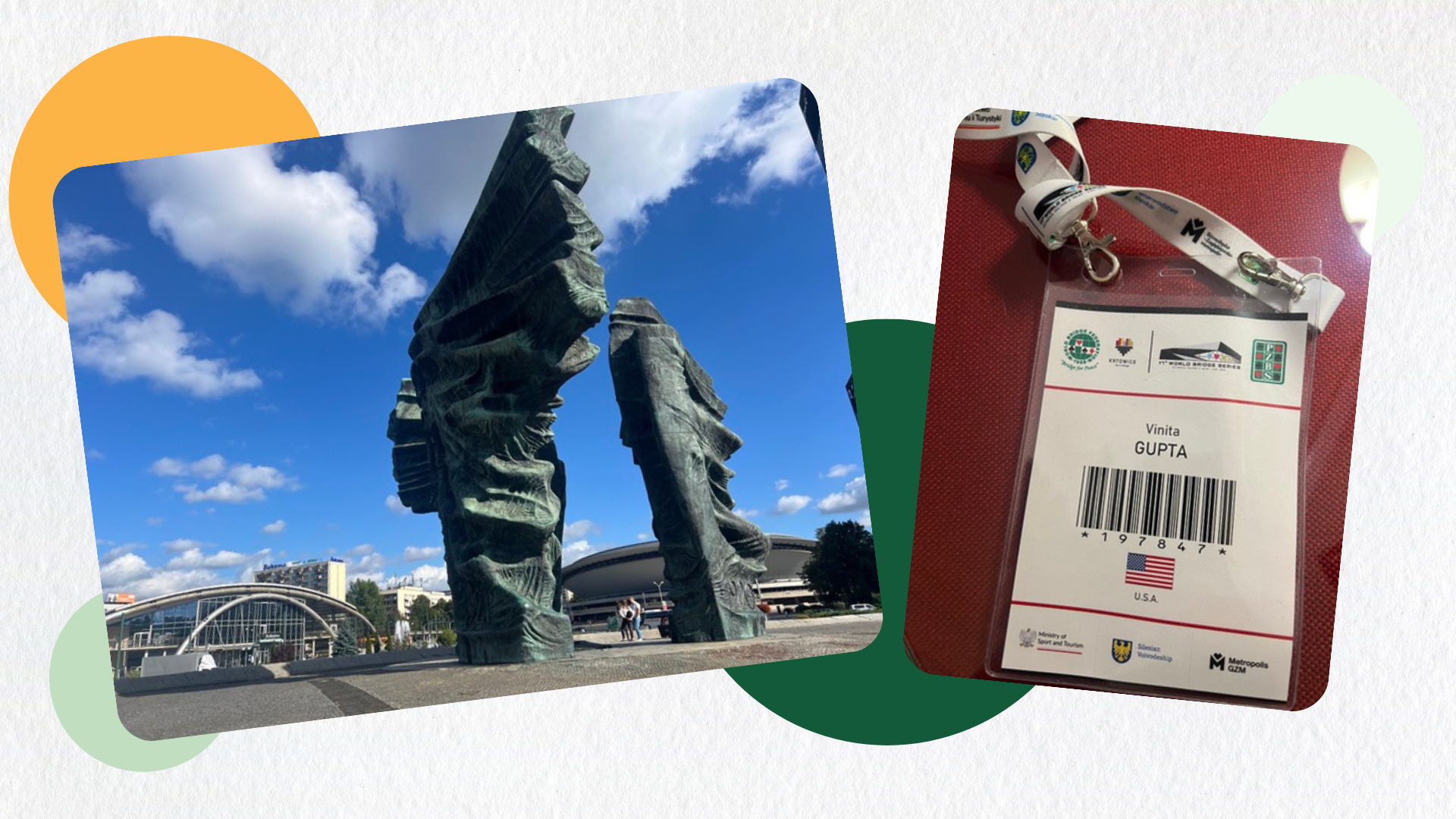
I was playing 14 straight days of intense bridge at the International Congress Centre (MCK), a dramatic angular building in Katowice, Poland — home to the World Bridge Series, championships conducted by the World Bridge Federation.
The seven-minute walk from my hotel, Voco, was bracing — temperatures like the San Francisco Bay Area, a slight breeze, softening the mind before an intense tournament. Around the hotel stood a cluster of extraordinary structures: the big arched tram station, a vast round arena, and a huge bronze monument with sweeping wings, commemorating the Silesian uprisings of 1919–1921, when locals fought for the right to join the newly independent Poland.
The MCK itself was tucked quietly among them — its entrance hall rising some 50 feet, opening onto a huge playing area and then a hall of wooden-partitioned bridge tables, organized and calming. I let my bridge brain relax, but my coach and partner, Morten, kept a slight tension, quizzing me through a few bridge conventions that I tended to forget. That is what one needs for good performance—calm waters with surface tension.
On my return journey, waiting in Frankfurt’s Senators Lounge, thoughts started floating: what were the new learnings to tuck into my mind from a two-week-long tournament?
Even after two decades of playing bridge, I was still struggling to put my own learnings into a workable framework to improve my tournament performance.
What struck me as odd was this: if AlphaFold can predict the shape of a protein in days — something that used to take human Ph.Ds nine to ten years — then why has AI been unable to defeat bridge masters?
Further research helped. AlphaFold solved a puzzle with one right answer — a protein’s shape, fixed by physics. Bridge has no fixed answer, because the line of play depends on bidding — a language that’s often incomplete, since the rules don’t cover every type of hand. Bridge is a game of probabilities. Further, AlphaFold has solved about 200 million protein structures. Bridge has more possible deals than there are grains of sand on every beach on Earth — combined many times over. No wonder AI can fold proteins but can’t yet master bridge.
When bidding rules don’t cover a hand type, new rules must be invented on the spot. In Poland, we all felt that most hands had very odd distributions — perhaps intentionally chosen by machines to see which players could describe them better and play them better.
In 2022, the headlines said ‘AI beats bridge masters’. A French AI called NooK, built by a company called NukkAI, reportedly beat eight bridge world champions in Paris, winning 83% of the sets played — playing against robots, not humans, across 800 deals.
I hadn’t heard of any of this — until I told Claude that no computer had ever beaten a bridge master. It corrected me immediately.
So why isn’t the bridge community talking about it?
I found a connection between the NooK reporting and what Andreas, our young, dynamic teammate, shared with us in Poland. Gloatingly, he proclaimed over dinner, “I won over $1,000 in an online bridge competition.” He’d practiced on his own, exploiting the robots’ weaknesses. “Robots are so dumb,” he said. “Plus they don’t learn.” He’d invested less than $100 practicing, and was proud of his ROI.
In NooK’s own announcement, the AI had also won by exploiting the similar kind of robot, opponents’ limitations — just like Andreas did.
Beating a robot’s blind spots, the way Andreas did, is one kind of skill. But that’s not the whole of bridge — or even the hard part. The real skill is in bidding: a shared language between partners that only gives a rough sketch of each hand, never the full picture. Reading between the lines of that sketch — and guessing how an opponent might be using that same ambiguity to mislead you — is where mastery actually lives. No AI has been tested against that yet, not really. NooK certainly wasn’t.
This is why true expert-level bridge competition remains an entirely different beast from games with transparent state spaces like chess. True mastery requires navigating incomplete information, deception, and psychological warfare in real-time alongside a partner.
Playing against tough opponents is what Poland was. That’s real competition. NooK never faced that.
Possibly AI gets there eventually. But not anytime soon, I predict.
2 responses
Vinita I am puzzled to read your scribe today – Ai aka Super intelligence – is at best striving to be a “tool” to aid Human cognitive skills along with Haptic skills – both unique attributes of humans. Machines can only add not supplement the Human. Why would you be questioning on who is superior intellect? Of course the Human cannot be bested by Machines – my prediction >> ever.
Grok says: “AI progress in Bridge has been limited mainly by investment, not by some fundamental impossibility. Bridge has never attracted the research budgets that Chess, Go, or poker did.”
I tend to agree with Grok.